
Real Estate Marketing · June 16, 2026
Portals vs. Platforms: Building Owned Lead Engines for Real Estate Dominance
Stop renting your audience. Build an owned real estate lead generation system using property SEO strategy in Singapore and high-intent Google Ads.
By Digital Squad

Dominating the property market requires shifting from "rented" portal visibility to a proprietary Real Estate Discovery Infrastructure. By prioritising real estate lead generation through high-intent Google Ads and district-level SEO, developers and agencies can capture buyers earlier in the journey, ensuring data sovereignty and higher conversion efficiency than third-party aggregators.
Is Relying on Third-Party Portals Limiting Your Scale?
In the Singapore and wider APAC property landscape, the default strategy for most firms has been a heavy reliance on third-party aggregators. While these portals provide immediate visibility, they create a systemic vulnerability: your brand is competing in a commoditised environment where you do not own the audience data or the user experience.
At Digital Squad, we view marketing as infrastructure. Relying solely on portals is akin to building a house on rented land. To achieve true market dominance, you must build an owned real estate discovery infrastructure. This involves moving away from disconnected property marketing tactics and toward an integrated growth engine that prioritises systems over spend.
The core tension to navigate is Human Experience x AI. While AI-native experimentation handles the high-volume precision of keyword bidding and audience segmentation, human-led strategy ensures that the brand’s boutique agility and unique value proposition are not lost in the automation.
How Does an Owned Platform Outperform Third-Party Portals?
The primary limitation of portals is the "dilution of intent." A prospect on an aggregator is, by definition, looking at your competitors. An owned platform, however, allows for a controlled, high-fidelity environment where you can move a prospect from initial interest to a scheduled viewing without the noise of a thousand other listings.
1. Data Sovereignty and Pipeline Clarity
When you control the platform, you control the data. You can track a user from their first search query for a "3-bedroom in District 10" through to the CRM entry. This level of granularity is essential for maintaining Direct-to-Developer Acquisition and ensuring that your ROAS is tied to actual commercial outcomes, not just impressions.
2. Capturing Intent via a Property SEO Strategy in Singapore
Portals often dominate broad terms, but they frequently leave gaps in hyper-local, long-tail search intent. A robust property SEO strategy in Singapore focuses on capturing buyers at the "discovery" phase—before they even reach a portal. This involves optimising for:
- Specific project names and "new launch" status.
- District-level lifestyle queries (e.g., "Best schools near Bukit Timah").
- Financial calculators and investment yield projections.
3. Precision via Google Ads for Real Estate Agents
While portals offer broad reach, Google Ads for real estate agents allows for surgical precision. By targeting high-intent commercial keywords, you can intercept buyers exactly when they are searching for their next investment. This ensures that your real estate lead generation efforts are focused on the most qualified segment of the market.
What Is the 3-Step Methodology for Building Discovery Infrastructure?
To move from insight to execution, Digital Squad employs a rigorous framework that ensures your growth engine is built on a foundation of measurable business outcomes.
Phase 1: Discover & Diagnose
We begin by auditing your current digital footprint. Where is your traffic coming from? If 90% of your leads are coming from "rented" sources, your infrastructure is at risk. We identify the high-intent keywords that your competitors—and the portals—are overlooking.
Phase 2: Design & Strategise
We architect a bespoke growth system that integrates search, paid media, and automated nurture sequences. This is where we define the Location-Specific Search Intent parameters. We don't just want any traffic; we want the specific buyer profile that fits your current inventory.
Phase 3: Activate & Optimise
We deploy the infrastructure. This is where our AI-native experimentation shines. We use machine learning models to optimise bidding strategies in real-time, while our human strategists refine the creative messaging to ensure it resonates with the sophisticated Singaporean buyer.
According to the 2025 National Association of REALTORS® (NAR) report, approximately 94% of homebuyers now use the internet as their primary search tool, with 87% starting their journey online before engaging an agent. If your digital infrastructure isn't guiding that initial search phase, you are losing control of your revenue pipeline to third-party gatekeepers.

Why Is Location-Specific SEO the Key to Precision?
In the Singapore real estate market, geography is everything. However, many brands fail to translate this into their digital infrastructure. Generalised real estate lead generation often results in high-volume, low-quality leads.
Dominance is achieved through precision over volume. By building out content silos focused on specific districts (CCR, RCR, OCR) and individual developments, you create an authoritative presence that search engines reward. This "marketing infrastructure" approach ensures that you are the first point of contact for buyers looking for specific residential solutions.
The Technical Stack for High-Intent Lead Capture Systems:
- Dynamic Landing Pages: Tailored to the specific ad group or search query.
- Automated Lead Scoring: Using AI to rank leads based on their interaction with your digital assets.
- Integrated CRM: Ensuring that no lead is lost and that every touchpoint is recorded for future attribution.
How to Balance AI Execution with Human Strategy?
The next decade of growth in real estate will be driven by those who can successfully integrate AI into their real estate lead generation systems without sacrificing the human element.
AI is unparalleled at managing the complexities of Google Ads for real estate agents, where thousands of variables (time of day, device, location, bid price) must be adjusted in seconds. However, AI cannot build the "Brand Tension" that makes a property development feel like a home or a sound investment.
At Digital Squad, our human experts lead the strategy, defining the "marketing infrastructure" architecture, while AI handles the high-frequency execution. This allows us to maintain boutique agility—responding quickly to market cooling measures or new launches—with enterprise discipline.
Technical Deep Dive: Building a Multi-Touch Attribution Stack for APAC Markets
In a fragmented market like APAC, a buyer might see a LinkedIn ad, search for a specific district on Google, and finally convert after receiving a retargeting ad on Instagram. Without a multi-touch attribution (MTA) model, you might incorrectly credit the final click while ignoring the infrastructure that nurtured the lead.
We implement server-side tracking and first-party data protocols to ensure that your attribution remains accurate even in a "cookieless" world. This provides Unit Economic Integrity, allowing you to see the true cost of acquiring a high-net-worth individual (HNWI) in markets like Singapore or Hong Kong.
The Economics of Data Sovereignty: Portals vs. Platforms
The hidden cost of portals is the "Data Tax." Every time a lead is generated on a third-party site, they keep the rich behavioural data—what other projects the user looked at, their budget range, and their timeline. You only get a name and a number.
By building a Real Estate Discovery Infrastructure, you reclaim that data. You can observe how long a user spends on your virtual tours or which floor plans they download. This intelligence allows for Hyper-Personalised SEO and email sequences that adapt to the buyer's unique stage in the journey, significantly increasing Pipeline Velocity.
Case Study Logic: Infrastructure in Action
Consider the difference between a "Campaign" mindset and an "Infrastructure" mindset for a new launch in District 9:
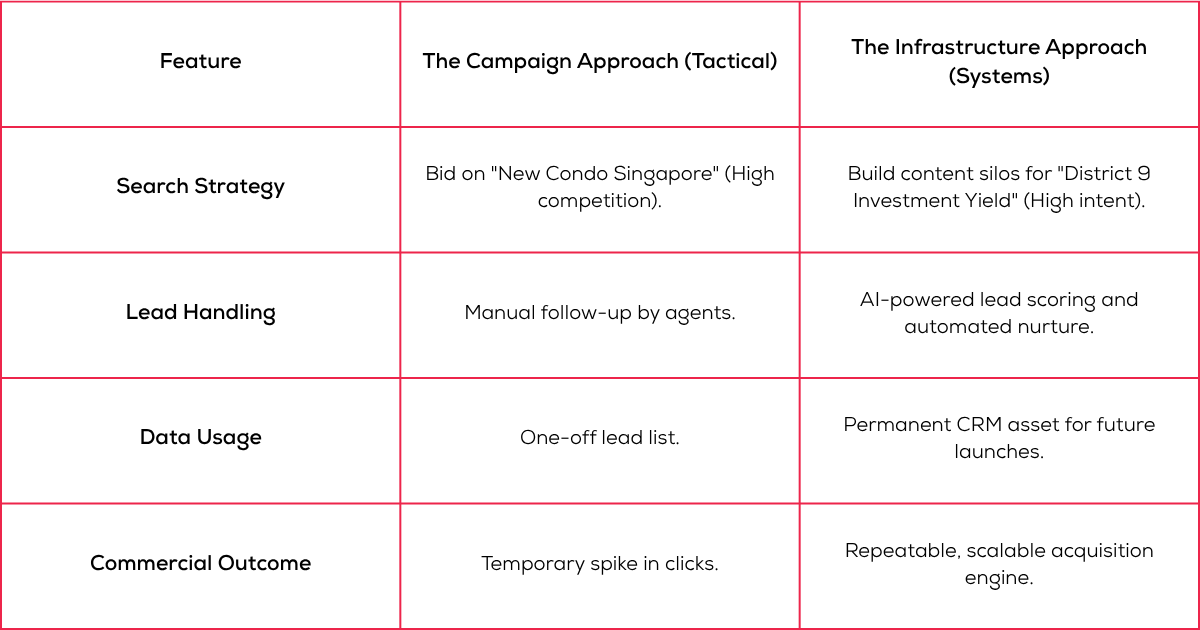
Is Your Infrastructure Built for Scalable Acquisition?
The goal of our real estate marketing agency Singapore services is to create a repeatable framework for success. A scalable system should not rely on the individual brilliance of a single agent or a lucky campaign. It should be a permanent part of your organisation’s operating system.
When marketing is viewed as infrastructure, you move away from the "stop-start" nature of traditional property advertising. Instead, you have a continuous "Discovery Engine" that:
- Reduces reliance on expensive, third-party portals.
- Lowers the long-term cost of acquisition.
- Increases the valuation of your brand by owning your audience data.
For real estate firms, well-designed digital workflows can reduce friction in repetitive coordination and give agents more time for high-value conversations. The priority is not automation for its own sake, but an owned lead-generation system that connects data, follow-up, and human judgment.
Securing Your Real Estate Dominance
The battle for real estate dominance in the next decade will not be won by those who spend the most on portals. It will be won by those who build the most robust, owned real estate lead generation infrastructure.
By moving "systems over spend" and focusing on lead generation, you take control of your commercial destiny. You move from being a tenant on a third-party portal to being the landlord of your own digital ecosystem.
Through a combination of property SEO strategy in Singapore, high-intent Google Ads for real estate agents, and a commitment to property marketing that prioritises business outcomes, you can ensure that your brand remains the primary destination for serious buyers.
Ready to Build Your Owned Lead Engine?
Stop renting your audience and start building your own growth infrastructure. Let Digital Squad help you move from insight to execution with a precision-engineered real estate system.