
AI Marketing · July 3, 2026
The Generative Search Era: How to Future-Proof Your Brand’s Visibility for AI Engines (GEO)
Traditional search is changing. Discover how to build a robust Generative Engine Optimisation (GEO) infrastructure to ensure your brand ranks in AI answers.
By Digital Squad

The landscape of digital discovery has fundamentally fractured. For over two decades, the playbook for organic visibility was predictable: identify high-volume keywords, optimize on-page metadata, build backlinks, and rank on page one of Google.
Today, that playbook is rapidly losing its monopoly over the buyer journey. Consumers and enterprise decision-makers are increasingly bypassing traditional search results entirely. Instead, they are turning to conversational interfaces—ChatGPT, Claude, Perplexity, and Google’s native AI Overviews—to get direct, synthesized answers to complex commercial queries.
A widely cited forecast from Gartner predicted that traditional search engine volume would drop by 25% by 2026 due to the rapid adoption of AI chatbots and virtual assistants.
We are no longer preparing for an AI-driven search economy; we are actively operating within it. To maintain digital market share, forward-thinking brands must look beyond legacy search tactics and invest in Generative Engine Optimisation (GEO). This means upgrading your digital footprint from basic web pages into an advanced informational infrastructure that AI engines can easily crawl, understand, and cite.
From SEO to GEO: Understanding the Algorithmic Difference
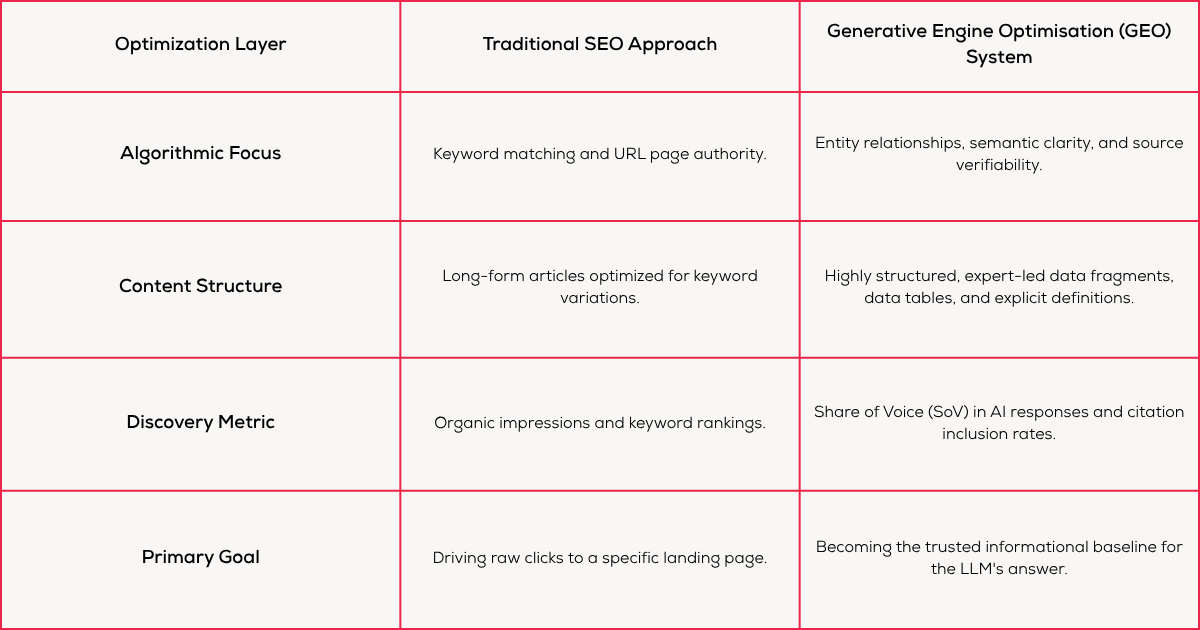
Traditional SEO treats search engines as indexers of documents. The algorithm looks for keyword density, structural formatting, and link equity to rank one document above another.
GEO recognizes that generative engines act as synthesizers of information. When a user asks an AI engine for a recommendation—for example, "What is the best enterprise marketing data infrastructure for a B2B SaaS company expanding into APAC?"—the model doesn't return a list of links. It parses its training data and live search indexes to construct a single, cohesive response, citing specific brands as authoritative references.
To win in this ecosystem, your content architecture must adapt to how LLMs evaluate data.
The Three Pillars of AI-Native Search Infrastructure
Future-proofing your brand's visibility within generative search requires a deliberate shift from volume-based content creation to structural precision. AI engines prioritize source materials that exhibit specific stylistic and technical traits.
By re-engineering your Search Engine Optimisation infrastructure, you position your brand to be consistently pulled into generative responses.
1. Advanced Technical Schema & Entity Mapping
LLMs rely heavily on clear structural hierarchies to confidently extract information. If your website's data is unstructured, an AI model will view your content as low-confidence information.
- The System: Implement exhaustive, hyper-specific Schema markup (such as Product, Organization, FAQ, and Article schema). This translates your human-readable copy into machine-readable data, explicitly mapping out the relationships between your brand, your services, and your industry.
2. Deep Information Density and "Citation Bait"
Generative engines prefer content that includes authoritative data, clear statistics, and unique points of view. Academic research into GEO frameworks indicates that including authoritative data tables, expert quotes, and precise numbers increases an article’s optimization score for AI citation engines by up to 30%.
- The System: When designing your content marketing strategy, eliminate generic, superficial summaries. Build comprehensive guides filled with proprietary statistics, comparative matrices, and definitive definitions that AI models can easily scrape and credit.
3. Off-Platform Footprint Alignment
AI models do not judge your brand's authority based solely on your own website. They cross-reference information across the broader web—including third-party review platforms, industry forums, news outlets, and digital databases. If your on-site messaging does not match your off-site digital footprint, AI models will register a discrepancy and omit your brand to avoid hallucinations.
- The System: Ensure absolute consistency in how your brand, core infrastructure, and product offerings are described across PR distributions, corporate registry profiles, and premium industry directories.
Balancing Human Experience with AI Execution
The core tension of the generative era is clear: while AI makes it incredibly easy to produce content at a massive scale, that very scale dilutes information quality. If your brand uses generic AI workflows to write generic blog posts, you are creating an echo chamber that generative search models will ultimately ignore. LLMs do not need to cite content that reads exactly like their own baseline training data.
This is where the human element serves as your ultimate differentiator.
At Digital Squad, we approach this by using an AI x Human Operating Engine. We leverage advanced AI models programmatically to mine massive intent data sets, identify emerging semantic queries, and monitor real-time AI citation trends.
However, the actual execution layer is firmly guided by human strategists. We draw directly from real-world expertise, case studies, and distinct market insights to inject genuine thought leadership into your digital presence. This unique perspective gives AI engines a compelling reason to source and quote your brand over competitors.
Measure What Matters: Tracking GEO Success
In the generative search era, relying solely on legacy organic traffic metrics can mask true performance. As AI engines answer more user queries directly inside their interfaces, traditional click-through rates (CTR) may experience structural changes.
Success must be measured by commercial visibility and brand integration within AI answers. Your new measurement framework should prioritize:
- AI Share of Voice (SoV): Tracking how frequently your brand name, frameworks, or products appear when prompt models generate industry recommendations.
- Citation Attribution Velocity: Monitoring the volume of high-intent referral traffic landing on your site directly via AI engine source links.
- Pipeline Quality: Ensuring that the traffic entering your ecosystem via conversational touchpoints converts at a higher velocity due to pre-established brand trust.
Transition from Search Visibility to Informational Dominance
Adopting an infrastructure-led approach means building digital assets that retain long-term value, regardless of how consumer search behavior shifts. The brands that continue to execute yesterday's campaign-driven SEO tactics will find themselves increasingly invisible to tomorrow's buyers.
Let us help you audit, design, and activate an organic search framework engineered specifically for the generative era. Contact our senior diagnostic team today, or discover how our unified Digital Marketing Agency solutions can insulate your pipeline and accelerate measurable growth.