Performance Marketing · July 2, 2026
Systems Over Spend: How to Fix a Stagnating ROAS Without Increasing Your Media Budget
Is your ROAS plateauing? Learn how to fix stagnating ad spend returns by optimising conversion efficiency, tracking data, and marketing infrastructure.
By Digital Squad

Every growth-focused brand eventually hits the invisible ceiling. You systematically increase your ad budgets on Google and Meta, expecting your revenue to climb proportionally. Instead, your Return on Ad Spend (ROAS) drops, your Customer Acquisition Cost (CAC) spikes, and your bottom-line margin begins to erode.
The traditional agency solution? Change the creative, swap the ad copy, or pump more budget into another speculative channel.
When media costs are rising, trying to spend your way out of a performance plateau is a losing strategy. Brands need to improve targeting, measurement, creative, landing pages, and follow-up so each unit of media has a stronger chance of producing commercial value.
The answer isn't more spend. It is better systems. If your ROAS has flatlined, the issue is not your ad budget—it is the underlying infrastructure handling that budget.
The Core Problem: The Efficiency Leak
When ad spend fails to yield proportional returns, businesses are usually suffering from an efficiency leak rather than a traffic problem. Buying traffic is easy; converting that traffic into high-quality pipeline revenue is where most enterprises fail.
When you operate with a campaign-first mindset, you isolate paid media performance from the rest of your digital ecosystem. To permanently correct a stagnating ROAS without adding a single dollar to your media budget, you must audit and re-engineer three specific infrastructural pillars.
Pillar 1: Upgrade to Server-Side Data Integrity
You cannot optimize what you cannot accurately measure. Relying strictly on standard browser-based cookie tracking means you are effectively running ad accounts with blindfolds on. Browser privacy rollouts, ad blockers, and data-loss incidents mean up to 30% of your conversion data never makes it back to the ad network's algorithm.
Without deep data feedback loops, ad platforms cannot accurately determine who your highest-value customers are. They optimize for shallow actions rather than actual closed-won sales.
The Fix:
Transition from basic pixel tracking to a robust, server-side data infrastructure using tools like Meta Conversions API (CAPI) and Google Enhanced Conversions. By routing data directly from your server or CRM straight to the ad platforms, you pass clean first-party conversion data back into the bidding models.
When the ad platform's AI machine-learning algorithms receive deep data signals, they shift bidding precision toward high-converting traffic segments, driving down waste and automatically scaling your ROAS.
Pillar 2: Turn Traffic into Pipeline via Conversion Architecture
Too many brands spend 95% of their energy on ad creatives and only 5% on the user experience that follows the click. Sending expensive, high-intent traffic from your Google Ads campaigns to a slow, generic corporate homepage is a guaranteed way to destroy your capital efficiency.
Consider the math behind conversion efficiency:
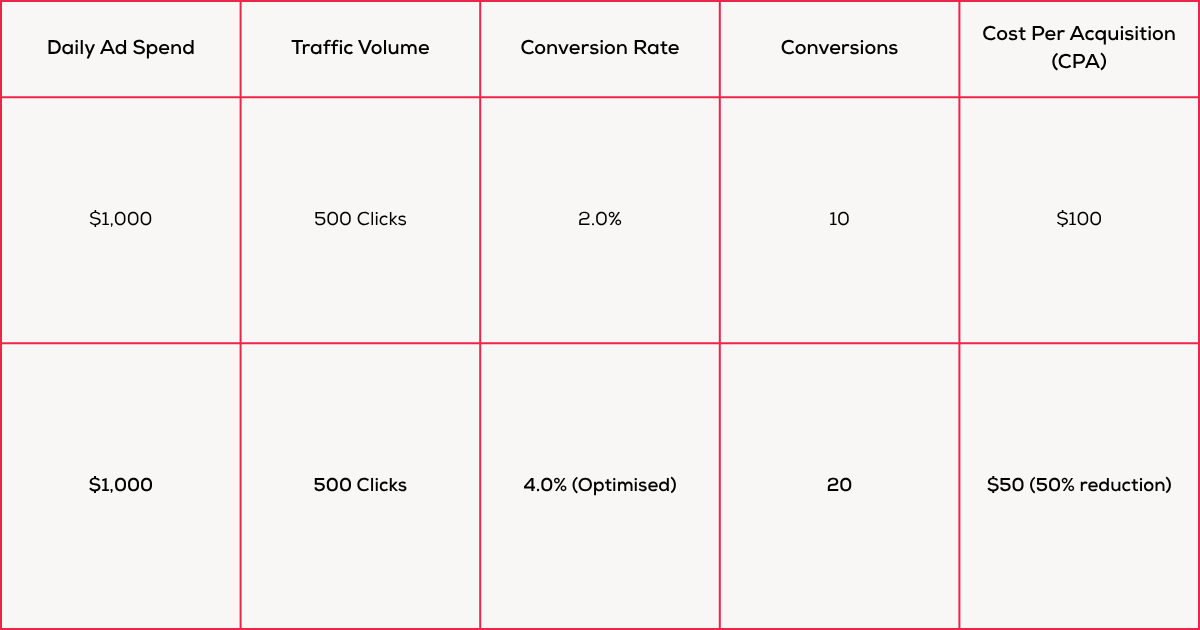
By systematically improving how your website handles traffic, you instantly double your acquisition output and double your ROAS without spending an extra penny on media buying.
The Fix:
Deploy a rigorous strategy focused entirely on conversion rate optimisation (CRO). Eliminate distractions on your landing pages, ensure lightning-fast mobile load times, match the landing page copy precisely to the keyword intent of the ad, and simplify forms to eliminate frictional user drop-off.
Pillar 3: Tighten Intent Dynamics (Precision over Volume)
A primary reason for an eroding ROAS is volume bias. Agencies often target broad, high-volume keywords to show impressive traffic increases in their reports. However, broad traffic usually brings low-intent audiences who browse but never buy.
If you are running search marketing campaigns, capturing raw clicks is a vanity metric. What matters is capturing high-intent demand that directly translates into pipeline quality.
The Fix:
Conduct a thorough intent audit across all paid acquisition channels.
- Audit Your Match Types: Move away from loose broad-match keywords that trigger your ads for irrelevant phrases, and rely on exact and phrase match options.
- Aggressive Negative Keyword Management: Build out exhaustive negative keyword lists to prevent your ads from showing up for informational queries (e.g., "how to do X for free") when you are selling enterprise systems.
- Coordinate with Organic Search: Align your paid efforts with your technical SEO infrastructure. If you already dominate the organic landscape for specific top-of-funnel keywords, reallocate your paid budget to target defensive, high-intent, bottom-of-funnel commercial keywords where conversion likelihood is highest.
The Commercial Reality: Fix the System, Protect the Margin
When macro market dynamics fluctuate, the knee-jerk reaction is to pull back on marketing completely or blindly shift budgets between platforms. Both choices ignore the real structural issue.
True marketing infrastructure treats paid media, content systems, tracking data, and website user experience as one cohesive organism. When these elements operate in harmony, you naturally insulate your business from rising platform ad costs.
Before you consider approving another budget increase request to hit your revenue goals, audit your internal operating engine. Look closely at your attribution loops, test your conversion flow latency, and question the commercial intent of your target keyword data.
Move your focus from spend-driven volume to system-driven precision. That is how you build a resilient, scaling growth engine that maximizes revenue while keeping acquisition costs firmly under control.
Ready to uncover the hidden leaks inside your marketing infrastructure? Let us evaluate your data structures, organic footprint, and customer acquisition paths. Explore our suite of comprehensive Digital Marketing Solutions or book a deep structural diagnostic audit with our senior consulting team today.