
Data Analytics · June 2, 2026
Decision Infrastructure: Moving from Vanity Metrics to Revenue-Led Analytics
Stop relying on vanity metrics. Learn how to build a robust Decision Infrastructure that connects marketing spend directly to CRM pipeline and closed revenue.
By Digital Squad

For the modern marketing organisation, data has never been more abundant. Yet, a fundamental disconnect persists inside executive boardrooms: marketing teams proudly report exponential growth in impressions, click-through rates, and traffic volume, while Chief Financial Officers look at stagnant revenue and ask where the capital went.
This friction stems from a reliance on vanity metrics. Tracking clicks and top-of-funnel actions provides an illusion of progress, but it fails to map the real commercial impact of marketing spend. When organisations optimise their budgets around superficial engagement data, they routinely waste resources scaling campaigns that fail to generate actual corporate pipeline.
To achieve sustainable growth, enterprise brands must shift their perspective. By building a mature Decision Infrastructure, businesses can move past vanity metrics and establish deep, revenue-led analytics models that connect every marketing activity directly to closed revenue and pipeline quality.
The Core Pitfalls of Vanity Metrics vs. Revenue Analytics
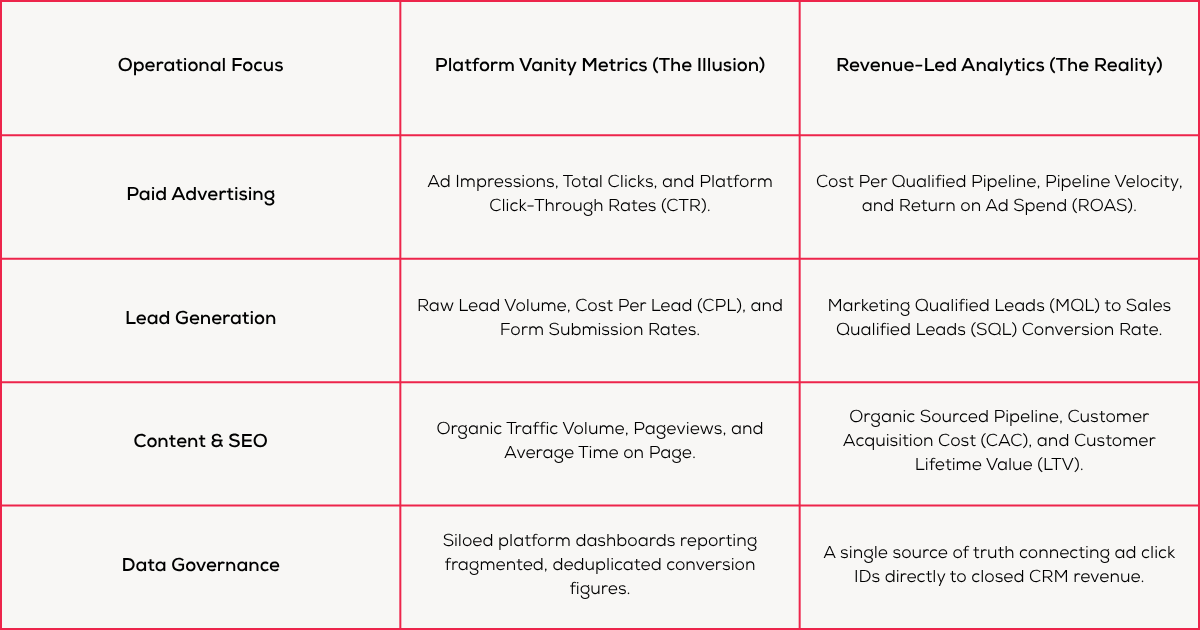
Vanity metrics are platform-centric indicators. They are easily manipulated, surface-level statistics that look impressive on a slide deck but possess zero correlation with net profit or pipeline velocity. In contrast, revenue-led analytics focus on business-centric outcomes.
Optimising campaigns based purely on cost-per-click (CPC) or raw lead volume can actively damage your pipeline. For instance, a lead generation campaign might deliver thousands of inexpensive eBook downloads, yet generate zero closed-won revenue because the audience lacks purchasing power.
The table below contrasts the metrics that distort marketing performance against the true financial indicators required to build a high-yield Decision Infrastructure:
Architectural Blueprint for a Revenue-Led Infrastructure
Transitioning away from platform vanity data requires an orderly restructuring of your data pipeline. You must bridge the gap between anonymous front-end web interactions and back-end commercial outcomes.
Unify Web Event Data with Your CRM:
Phase 1: Attribution Integration.
Ensure your web analytics architecture captures granular conversion variables, such as Google Click Identifiers (gclid) and UTM parameters, and maps them directly into your Customer Relationship Management (CRM) platform upon form submission.
Decommission Last-Click Attribution:
Phase 2: Modeling.
Move away from outdated single-touch attribution models that credit 100% of a sale to the final click. Implement multi-touch or data-driven attribution models to accurately evaluate how top-of-funnel content influences long-term contract values.
Establish Closed-Loop Data Feedback Loops:
Phase 3: Operational Optimisation.
Program your CRM to feed offline conversion data back into your digital advertising platforms. By passing closed-won sales data back to search and social algorithms, you train your ad networks to optimise for buyers rather than casual browsers.
Deploy Executive Revenue Dashboards:
Phase 4: Dashboard Governance.
Consolidate your marketing data into unified business intelligence engines. Eradicate platform-specific reports and replace them with single-source-of-truth dashboards that measure marketing performance strictly through pipeline value and customer acquisition efficiency.
Elevating Pipeline Quality Over Lead Volume
When your decision infrastructure is tuned to revenue, the relationship between marketing and sales teams fundamentally transforms. Marketing is no longer evaluated on how many forms were filled, but on the quality and velocity of the pipeline they generate.
With a revenue-led model, you can track an asset's exact financial yield. If a specific paid search campaign generates fewer leads but boasts an exceptionally high SQL-to-Closed-Won conversion rate, your data infrastructure flags it as a high-value priority. This allows you to aggressively reallocate budget toward channels that create real business value, maximising the return on every pound of your marketing investment.
Engineer Your Revenue Infrastructure with Digital Squad
Building a sophisticated, revenue-led decision infrastructure requires deep technical integration, data science proficiency, and strategic clarity.
At Digital Squad, we design and deploy end-to-end analytics ecosystems that eliminate tracking blind spots. We help enterprise organisations integrate web touchpoints with internal CRMs, configure advanced attribution models, and optimise digital budgets around commercial outcomes. Move beyond surface-level tracking and transform your marketing data into a predictable growth engine.