B2B Marketing · August 7, 2026
Dark Social in B2B: Why Your Best Leads Never Click a Tracked Link
Dark social explained: why your analytics dashboard is quietly hiding where your best B2B leads actually come from, and what to do about it.
By Digital Squad
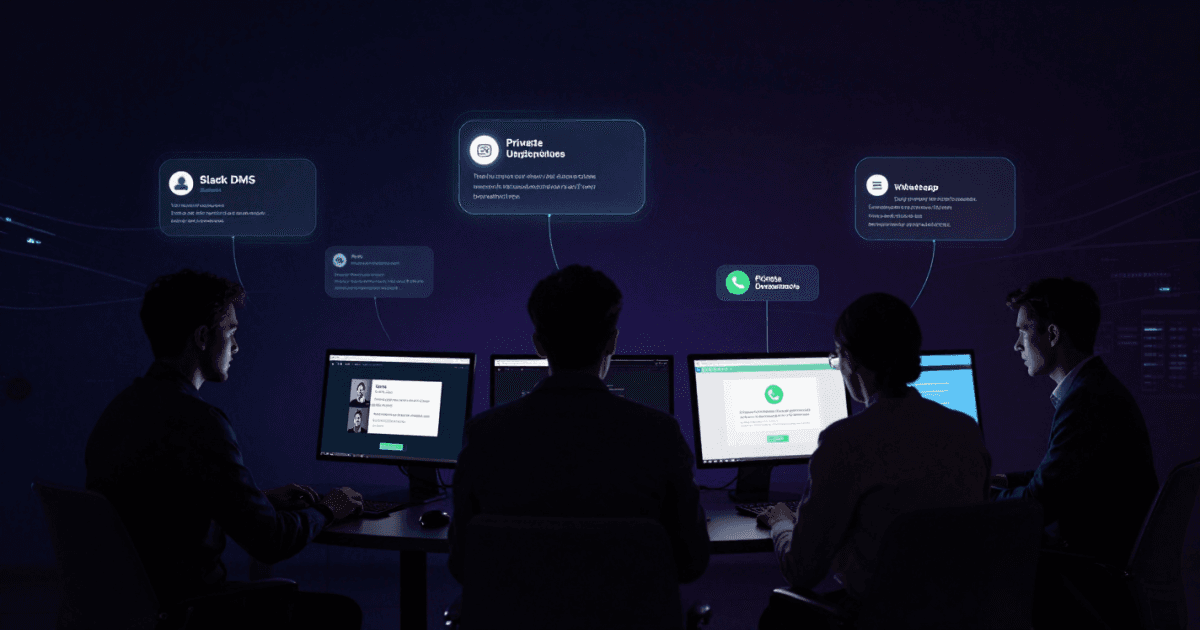
Open your analytics dashboard and look at the "Direct" traffic line. Some of that is genuinely people typing your URL into a browser from memory. A significant chunk of it almost certainly isn't. It's a Slack message with your case study pasted into it, a forwarded email with your pricing page linked, or a CFO asking their network "who's the best vendor for this?" and getting your name back in a private DM. None of it left a trace your analytics tool can read — and in B2B, this invisible layer is often where deals actually get decided.
The Discovery
The concept has a surprisingly precise origin. In 2012, journalist Alexis Madrigal noticed something odd in The Atlantic's own analytics: an enormous, unexplained volume of "direct" traffic that didn't behave like people typing URLs from memory. Working with the publication's analytics provider, he found that a large majority of what looked like direct traffic was actually content shared through private channels — email, messaging apps, and copy-pasted links — that simply left no referrer data behind. He called it dark social, and the term stuck.
Dark social is any web traffic generated by content sharing that happens through private, untrackable channels — email, DMs, Slack, WhatsApp, Microsoft Teams — which shows up in analytics tools as "direct" traffic because there's no referral data attached to it. Wikipedia's summary of the concept notes that Madrigal's original finding has held up broadly across the wider web in the years since, with private sharing consistently accounting for a substantial share of what analytics tools misclassify as direct.
Why This Matters More in B2B Than Almost Anywhere Else
Consumer dark social is mostly people forwarding articles to friends. B2B dark social is where actual buying decisions get made. Buying committees don't research in public — they research in Slack channels, forwarded email threads, and internal shared documents, exactly the channels dark social measurement can't see into.
Think about what that CFO scenario at the top of this article actually represents: a genuine recommendation, delivered with more trust and influence than almost any paid or organic channel could produce, and completely invisible to whoever's building the monthly marketing report. Multiply that across every buying committee independently researching, discussing, and forming a shortlist internally before a single member of that committee ever fills out a form, and the scale of what's hidden becomes clear.
The Evidence You're Actually Missing
Attribution gets systematically distorted. Deals that genuinely originated from a well-shared piece of content get logged as "direct" or "unknown source," which understates the performance of the content and channels doing the real work of influencing a purchase decision, while overstating the apparent performance of whatever channel happened to be tracked at the final, visible touchpoint.
Content performance looks worse than it is. A whitepaper or case study that gets forwarded extensively inside target accounts, without ever generating a trackable social share, will show modest traffic and engagement numbers in most standard reporting, even if it's doing more to move deals forward than a piece of content with ten times the visible traffic.
Budget quietly shifts toward what's measurable, not what's effective. When leadership can only see performance for trackable channels, spend naturally drifts toward paid and other easily attributed activity, even when word-of-mouth and internal sharing are doing more of the actual persuading — simply because the persuading channel can't produce a number for a dashboard.
Gathering What Evidence You Can
Dark social can't be fully measured — that's inherent to what makes it dark. But a few practical steps recover a meaningful amount of visibility.
Segment "direct" traffic by landing page. Genuine direct visits typically land on a homepage or a well-known URL someone actually remembers. Direct traffic landing deep on a specific blog post or resource page is a strong sign of dark social sharing, not someone typing a long URL from memory.
Use UTM-tagged short links in anything meant to be shared. Newsletters, PDFs, and sales-shared content should carry trackable links wherever the format allows, so at least some private sharing can be recaptured with real attribution data rather than falling into an unexplained direct bucket.
Ask directly, at the moment it's easiest to answer. A simple "how did you hear about us?" field on a demo request form, or a direct question early in a sales call, recovers attribution data no analytics tool can capture on its own — and in B2B, buyers are generally willing to answer honestly, since there's no reason not to.
Track branded search as a proxy signal. A rise in branded search volume that isn't explained by a corresponding paid or trackable campaign is often a downstream signal of dark social activity — people who heard about you privately, then went looking for you directly.
Treat sales as a data source, not just a channel. Reps hear "someone on my team sent me this" constantly in discovery calls. That information rarely makes it back into a CRM field or a marketing report, but it's some of the most direct evidence of dark social influence available, and it costs nothing to start capturing systematically.
What This Should Change About How You Report Performance
None of this means abandoning trackable attribution — it means holding it a little more loosely, particularly for content built to be forwarded and discussed internally rather than clicked on directly. A whitepaper, a detailed comparison guide, or a sharp piece of thought leadership is often specifically the kind of content that gets pasted into a Slack channel rather than shared as a public social post, which means judging its performance purely on trackable clicks will consistently undersell it.
The more useful question isn't "how do we eliminate dark social" — that's not achievable — but "which of our content is clearly built to be shared privately, and are we creating enough of it, even though it will never show up cleanly in a dashboard."
Stop Optimising Only for What You Can See
The most persuasive moment in a B2B deal is often a private conversation you'll never get to measure directly. That doesn't make it less real — it makes the parts you can measure a smaller, more misleading slice of the full picture than most dashboards let on.
Digital Squad builds reporting that accounts for this rather than pretending it doesn't exist. Our data analytics work layers in the recovery signals — landing page segmentation, UTM discipline, branded search tracking, and CRM source-of-truth fields — that claw back visibility into what's actually driving pipeline, alongside what's cleanly trackable. And because dark social rewards content built to be forwarded and discussed, not just clicked, our content marketing team builds specifically for that — the whitepapers, comparison guides, and thought leadership pieces that end up pasted into a private Slack channel, which is often exactly where B2B deals get decided. If your best-performing content on paper isn't the content your sales team keeps hearing about anecdotally, that gap is worth investigating.