
Digital Marketing · July 7, 2026
The CMO’s Dashboard: How to Measure What Actually Matters in 2027
Stop reporting on vanity metrics. Discover the core financial ratios and pipeline metrics every CMO dashboard needs to command respect in the C-suite.
By Digital Squad

For years, marketing metrics have lived in a state of comfortable isolation. Marketing teams reported on click-through rates (CTR), search impressions, and lead volumes, while the rest of the C-suite discussed EBITDA, customer lifetime value (LTV), and pipeline conversion rates.
As we enter 2027, that disconnect is no longer sustainable.
In a fiscal environment characterized by flatlined budgets and intense scrutiny over ad spend, CMOs face immense pressure to justify every dollar. According to Gartner’s 2026 CMO Spend Survey, marketing budgets remain highly constrained, forcing marketing leaders to fund digital transformation through tighter prioritization and resource reallocation. Simultaneously, data from the 2026 CMO Survey by Fuqua/Deloitte reveals that short-term performance pressures from CEOs and boards are forcing marketing departments to focus ruthlessly on what they can directly control: efficient revenue generation and customer retention.
If your marketing dashboard is still dominated by platform-level vanity metrics, you are not measuring value—you are measuring noise. To command authority in the boardroom, the modern CMO dashboard must be built on a robust, connected marketing infrastructure that speaks the language of corporate finance.
Stop Reporting Channel Metrics to the Board
One of the most common operational mistakes is presenting channel-level metrics to the board. Your CFO does not need to know the CPC of your Google Ads campaigns or the organic impression growth from your technical SEO strategy. Those are internal operational diagnostic metrics, not business performance indicators.
To build a dashboard that commands respect, you must divide your metrics into two distinct categories:
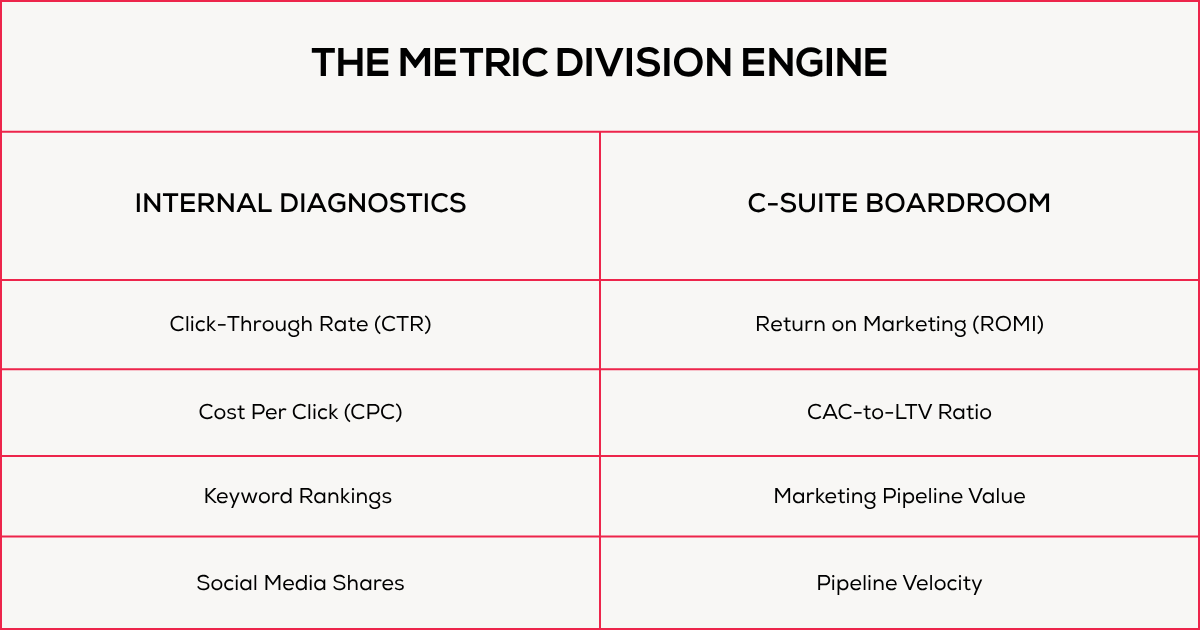
By keeping diagnostic metrics inside the marketing department for real-time campaign optimization, you protect the board from strategic distraction and focus their attention on the metrics that directly impact enterprise valuation.
The Four Pillars of the 2027 CMO Dashboard
A revenue-focused dashboard should give executive stakeholders immediate, clean visibility into the health of your marketing operating system. The board should be able to look at a single dashboard screen and answer one question: How efficiently is marketing converting capital into profitable growth?
To answer this, your dashboard must focus on four core pillars.
1. Return on Marketing Investment (ROMI)
Rather than looking at Return on Ad Spend (ROAS)—which only measures immediate ad revenue against raw media buy—the C-suite requires ROMI. This ratio factors in the total cost of your marketing operations, including agency retainers, MarTech software, content production costs, and personnel.

If your ROMI is positive and climbing, your marketing infrastructure is operating as a value multiplier, making it significantly easier to secure additional budget allocations from the CFO.
2. The Customer Unit Economics (CAC : LTV)
Your dashboard must track the relationship between Customer Acquisition Cost (CAC) and Customer Lifetime Value (LTV). Specifically, it must monitor the CAC Payback Period—the exact number of months it takes for a new customer to generate enough gross margin to recoup their acquisition cost.
- The Target Ratio: B2B enterprise and high-growth scale-ups should target an LTV-to-CAC ratio of at least 3:1.
- The Payback Target: A payback period of under 12 months is the gold standard for maintaining a healthy cash-flow profile.
By monitoring these ratios, you show the board that you are not simply buying traffic, but engineering sustainable, long-term customer profitability.
3. Pipeline Velocity and Contribution
If your marketing systems are isolated from your sales CRM, you cannot track pipeline velocity. A modern dashboard tracks the time it takes for a prospect to move from their initial digital discovery touchpoint to a closed-won opportunity.
Key metrics to track in this pillar include:
- Marketing-Influenced Pipeline: The total value of active opportunities where marketing assets (like targeted search, social, or content) played a measurable touchpoint.
- Lead-to-Close Conversion Rate: The percentage of marketing-sourced leads that translate into closed revenue.
- Sales Cycle Velocity: The average number of days required to move an opportunity through your funnel.
4. Share of Voice (SoV) and AI Citations (GEO)
As consumer behavior pivots away from standard search engines and toward conversational AI models, tracking your organic footprint is changing. Your dashboard should reflect your AI citation share—how often your brand is recommended as an authority by systems like ChatGPT, Claude, and Google’s AI Overviews.
Tracking this metric ensures your organic SEO infrastructure is adapted to capture next-generation search queries.
Why Better Measurement Starts with Better Infrastructure
You cannot build an accurate dashboard on a broken data foundation. Effective marketing analytics infrastructure connects spend, customer behaviour, pipeline, and revenue so teams can identify underperforming investment and redirect it with confidence.
If your data is trapped in separate platforms—where Google Ads reports one conversion figure, your CRM reports another, and Google Analytics displays a third—your dashboard will remain inaccurate.
To resolve this, you must move away from disconnected tools and install a unified marketing infrastructure. This means:
- Standardizing your data collection via server-side tracking to bypass browser data loss.
- Connecting your advertising systems directly to your CRM to enable closed-loop attribution.
- Aligning your B2B marketing strategies so that every content download, search ad click, and email nurture flow contributes to a single, unified profile of the buyer.
When your underlying infrastructure is robust, your executive dashboard updates automatically with clean, reliable data. You move from defensive, backward-looking reporting to forward-looking, strategic optimization.
Run Your Marketing Like a Business, Not a Campaign
The CMOs who thrive in the coming years will be those who run their marketing departments like disciplined investment portfolios. Every channel, campaign, and content piece must be evaluated on its ability to drive predictable pipeline and margin growth.
Stop reporting on activities. Start measuring outcomes.
Let us help you audit your tracking structures, align your customer acquisition paths, and build a high-precision measurement engine. Explore our comprehensive Digital Marketing Solutions in Singapore or contact Digital Squad today to schedule an initial diagnostic audit of your data systems.