Search Engine Optimisation · June 24, 2026
Closing the SEO Efficiency Gap: Transforming 500,000 Impressions into a Scalable Lead Engine
500,000 impressions but ranking at position 54? Learn how Digital Squad's 6-pillar framework transforms ranking depth into a scalable organic lead engine.
By Digital Squad

The Uncomfortable Truth Hidden in Your Google Search Console
Your Google Search Console is telling you something most agencies would rather you ignore.
Imagine a page on your domain racking up 500,000 impressions over a reporting period for one of the most commercially valuable queries in your market. That sounds like success — until you look at the average position. Position 54. Page five or six of Google. A place where, statistically, fewer than 0.5% of searchers ever venture.
Those 500,000 impressions represent real people actively searching for a service you provide. They are not browsing passively. They are in the market, comparison-shopping, ready to hire. And they cannot see you.
This is the SEO efficiency gap — the chasm between visibility potential and actual lead generation — and it is far more common, and far more costly, than most business owners realise.
This post examines how to diagnose it, why it persists, and — more importantly — how a structured, evidence-based programme converts dormant impression volume into a compounding lead engine.
What Is the SEO Efficiency Gap?
The SEO efficiency gap describes a specific condition: a page has significant search impression volume but insufficient ranking depth to generate meaningful click-through traffic.
Impressions without ranking depth are a bit like owning a retail space in a busy shopping centre but being located on the sixth floor with no signage and a broken lift. Footfall walks past every day. Nobody finds you.
The maths make this vivid. Consider a high-volume commercial query — say, one attracting 10,000 monthly searches in your target market. At position one, you can expect a click-through rate (CTR) of approximately 27–28%. That is roughly 2,700 monthly visitors from a single keyword.
At position 54, your effective CTR is functionally zero. Search traffic data consistently shows that the top three organic results capture over two-thirds of all clicks on a search results page, and results beyond page one receive less than 5% of total traffic combined.
The difference between position one and position 54 on a 10,000-search-per-month keyword is not incremental. It is the difference between approximately 2,700 monthly visitors and approximately zero.
Now scale that across 500,000 annual impressions on a single high-intent page. The unrealised value becomes very large, very quickly.
Why High-Impression Pages Get Stuck at Ranking Depth
Understanding the gap requires understanding why capable pages stall at deep positions despite accumulating significant impression volume. There are five structural reasons this happens.
1. Topical Authority Is Shallow
Google's algorithm, and increasingly the large language models (LLMs) powering generative search experiences, reward demonstrable expertise across a topic cluster — not just on a single target page. A page targeting "SEO agency Singapore" will struggle to rank competitively if the surrounding domain lacks supporting content that establishes authority on adjacent subjects: technical SEO, local SEO strategy, content strategy for Singapore markets, E-E-A-T signals, and so on.
Without topical depth, the page is isolated. Google can see that it is relevant to the query — hence the impressions — but cannot confirm that the domain is authoritative enough to deserve top-three placement.
2. On-Page Alignment Is Off
The most common on-page failure is a mismatch between content structure and search intent. High-volume commercial queries carry specific intent signals — typically a combination of informational ("what does an SEO agency do?") and transactional ("which agency should I hire?"). A page that over-indexes on one whilst neglecting the other will rank poorly despite technical correctness.
Additionally, title tags, H1s, meta descriptions, and semantic keyword distribution all influence both CTR and ranking signals. A page sitting at position 54 is frequently one whose on-page architecture was set up years ago and has not been systematically audited since.
3. Backlink Profile Is Insufficient or Misaligned
For highly competitive commercial queries — and "SEO agency [city]" queries are among the most competitive verticals in digital marketing — the off-page authority required to rank in the top five is substantial. What matters is not just the volume of referring domains, but their topical relevance, domain authority, and the anchor text distribution pointing to the target page.
A page receiving its first backlinks from generic directories is not competing against pages earning editorial links from industry publications. The authority gap compounds over time if left unaddressed.
4. Core Web Vitals and Technical Signals Are Dragging Performance
Google confirmed Core Web Vitals as a ranking signal in 2021, and their influence on competitive rankings — particularly in crowded verticals — has only deepened. Pages with suboptimal Largest Contentful Paint (LCP), poor Cumulative Layout Shift (CLS), or weak Interaction to Next Paint (INP) scores are at a structural disadvantage relative to competitors who have invested in page experience.
Technical issues extend beyond Core Web Vitals: crawlability problems, duplicate content, canonical tag misconfigurations, and internal linking gaps all suppress ranking potential for otherwise strong pages.
5. E-E-A-T Signals Are Underdeveloped
Google's Quality Rater Guidelines place significant weight on Experience, Expertise, Authoritativeness, and Trustworthiness (E-E-A-T). For commercial queries in professional services — where high impression volume pages typically live — E-E-A-T signals are particularly important because the searcher is making a high-stakes purchasing decision.
Pages lacking author bios, client case studies, third-party reviews, industry accreditations, and demonstrable real-world outcomes will consistently lose out to competitors whose pages clearly signal trustworthiness.
The Generative Engine Dimension: Why GEO Changes the Stakes
The SEO efficiency gap has historically been a purely traditional-search problem. In 2025 and 2026, it has become something more complex — and more urgent — because of the rise of generative search.
AI-powered answer engines — Google's AI Overviews, ChatGPT Search, Perplexity, and Gemini — now intercept a material portion of search queries before users reach organic results. Research published in early 2026 found that AI Overviews correlate with a 58% reduction in CTR for top-ranking pages on affected queries, and that approximately 58.5% of US Google searches now end without a click to any external website.
This changes the calculus in two ways.
- First, the urgency of achieving top-three rankings on high-volume commercial queries is heightened, not reduced. For transactional and commercial queries — the kind where someone wants to hire an SEO agency — the evidence suggests AI Overviews have a smaller CTR impact than on informational queries. The buyer is clicking through. You need to be there for them to find.
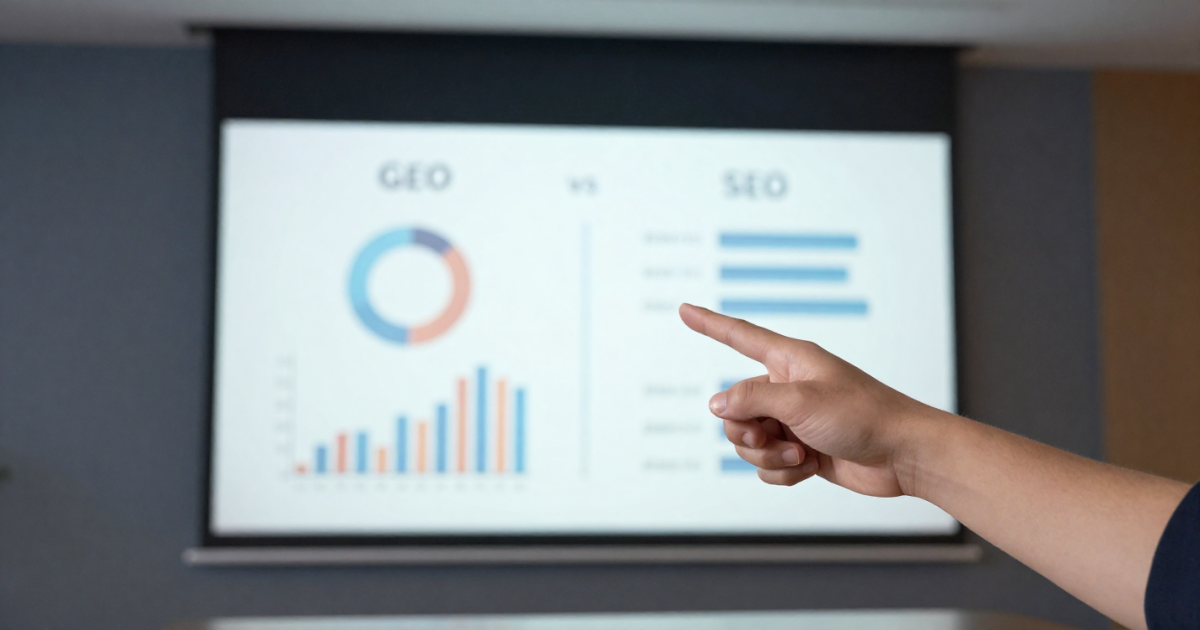
- Second, brands that invest in Generative Engine Optimisation (GEO) — structuring content to be cited by LLMs, earning brand mentions in third-party publications, achieving strong E-E-A-T signals — compound their returns from traditional SEO rather than cannibalising them. Research indicates that brands are 6.5x more likely to be cited in AI-generated answers through third-party sources than through their own domain content alone. The off-page work you do to close the SEO efficiency gap directly feeds your GEO presence.
In short: the two disciplines are not competing priorities. Closing the traditional SEO efficiency gap is a prerequisite infrastructure for GEO success.
The Efficiency Gap Playbook: A Six-Pillar Framework
Moving a high-impression, deep-ranking page into the top five requires a structured programme, not a collection of one-off tactics. At Digital Squad, our approach to closing the efficiency gap is built around six interconnected pillars.
Pillar 1: Precision Keyword Architecture
Before any content or technical work begins, the keyword strategy requires a forensic review. The goal is not to identify a single target keyword — that's already identified — but to map the full query universe surrounding the target page.
This involves:
- Intent mapping: categorising queries by informational, commercial, and transactional intent, and understanding which content types Google rewards for each
- Keyword clustering: grouping semantically related queries into content clusters that the target page can either address directly or benefit from through supporting pages
- Competitive gap analysis: identifying which high-relevance queries your top-ranking competitors are capturing that you are not
- Search landscape mapping: auditing how AI Overviews, People Also Ask boxes, local packs, and Featured Snippets appear for priority queries, and determining which content formats are most likely to earn these positions
The output is a prioritised keyword architecture that aligns every subsequent content decision to ranking opportunity.
Pillar 2: On-Page Optimisation and Content Depth
The target page itself — in this case, a commercial landing page for a high-volume query — requires both structural and substantive improvement.
Structural improvements typically include:
- Rewriting title tags to balance keyword inclusion with compelling CTR signals (specificity, value propositions, and trust markers all lift CTR relative to generic titles)
- Rebuilding H1/H2/H3 hierarchy to match query intent and support featured snippet eligibility
- Expanding body content to address the full range of searcher sub-questions, whilst maintaining the commercial conversion focus of the page
- Implementing structured data (Schema.org) for local business, reviews, FAQ, and service types to enable rich result eligibility
- Tightening internal linking so that equity from authoritative pages on the domain flows directly to the target page
Content depth is frequently the most impactful lever. Pages ranking in position one for competitive commercial queries typically carry significantly more comprehensive, intent-matched content than pages ranking at position 50. The gap is rarely a few hundred words — it is often a qualitative difference in how comprehensively a page answers every question a prospective buyer might have.
Pillar 3: Topical Authority Building Through Content Clusters
The target page cannot rank in isolation. Authority signals need to flow from a broader content ecosystem that demonstrates genuine domain expertise in the surrounding topic area.
The hub-and-spoke model — where the commercial landing page is the hub and a series of educational, research-based content pieces are the spokes — does two things simultaneously:
- It signals topical authority to Google's algorithm by demonstrating coverage depth across the subject matter
- It captures long-tail search traffic at the awareness and consideration stages of the buyer journey, creating multiple entry points that funnel towards the commercial page
For a high-impression commercial page, the content programme typically involves publishing 6–12 supporting pieces over a 90-day period, each targeting a specific cluster of related queries. This is not generic content production — it requires each piece to be genuinely useful, properly linked to the hub, and structured to attract backlinks in its own right.
Pillar 4: Off-Page Authority and E-E-A-T Signals
Backlink acquisition for competitive commercial queries requires a strategic, editorial approach rather than a tactical, volume-focused one.
The most effective off-page strategies for closing the efficiency gap include:
- Digital PR: securing coverage and links from relevant industry publications, business media, and sector-specific platforms. A single link from a high-authority, topically relevant publication carries more ranking impact than dozens of links from generic directories.
- Expert contribution programmes: placing thought leadership content — bylined articles, expert commentary, research contributions — in third-party publications. These simultaneously build backlinks, E-E-A-T signals, and GEO citation potential.
- Client testimonial and review syndication: actively managing the presence and volume of reviews on Google Business Profile, Trustpilot, Clutch, and sector-specific platforms. Review signals contribute to local SEO performance and E-E-A-T, and research suggests that profiles on review platforms increase LLM citation likelihood by approximately 3x.
- Competitor link gap analysis: systematically identifying domains linking to top-ranking competitors but not to the target page, and pursuing those through relevance-based outreach.
E-E-A-T enhancement on the page itself — through author credentials, client case studies, accreditations, and demonstrable track records — should run in parallel with off-page link acquisition. Google's systems increasingly evaluate both together.
Pillar 5: Technical SEO and Core Web Vitals
Technical issues are the silent suppressor. A page with excellent content and a growing backlink profile will still underperform if it has material technical problems undermining its ranking potential.
A technical audit for efficiency gap closure focuses on:
- Crawlability and indexation: ensuring Google can access and correctly index the target page and its supporting content without barriers
- Site architecture and URL structure: confirming the page is positioned correctly within the domain hierarchy to receive maximum internal linking equity
- Core Web Vitals: measuring and improving LCP, CLS, and INP scores to meet or exceed category benchmarks
- Mobile experience: verifying that the mobile version of the page meets Google's mobile-first indexing standards, which has been the default indexing methodology since 2021
- Page speed optimisation: compressing images, implementing lazy loading, minimising render-blocking resources, and leveraging browser caching
- Schema implementation: deploying and validating structured data to support rich result eligibility
Technical improvements rarely move rankings alone, but they remove the ceiling that prevents strong content and authority signals from translating into top-five positions.
Pillar 6: Conversion Architecture and Lead Capture
Closing the efficiency gap is not solely about achieving a higher ranking. The commercial objective is leads and revenue — which means the traffic earned through improved ranking must convert at a meaningful rate.
A page moving from position 54 to position five will see a step-change increase in traffic volume. Without conversion-ready architecture, much of that traffic exits without engaging. The conversion work runs in parallel with the ranking programme:
- Clear, singular calls-to-action above the fold and at strategic scroll depths
- Social proof elements (client logos, case study summaries, award badges, review scores) placed at decision points within the content
- Lead capture forms optimised for friction reduction — asking only for what is genuinely necessary at the first point of contact
- Page speed optimisation, which simultaneously improves Core Web Vitals and reduces abandonment
- A/B testing of headline, CTA, and form variants as traffic volume increases
The efficiency gap framework closes the loop: driving traffic is only half the work. Converting that traffic into leads is the other half, and both deserve equal rigour.
What the Numbers Look Like When It Works
Consider the trajectory of a commercial page moving from position 54 to position five on a query generating 10,000 monthly searches.
At position 54, effective clicks are negligible — well below 100 per month, possibly zero, depending on the query's featured snippet and local pack behaviour.
At position five, research-based CTR benchmarks suggest approximately 5–7% click-through. On 10,000 monthly searches, that is 500–700 monthly visitors, from a single keyword.
At position two or three — a realistic outcome of a sustained 12–18 month programme for a competitive query — CTR benchmarks approach 11–16%, delivering 1,100–1,600 monthly visitors from that keyword alone.
Across a cluster of related queries — the supporting long-tail terms captured by the content programme — total organic traffic from the cluster can reach multiples of the primary keyword's contribution.
If that traffic converts at even 2–3% into qualified enquiries (a conservative benchmark for a well-optimised commercial services page), the arithmetic becomes compelling:
- 1,500 monthly organic visitors
- 3% conversion rate
- 45 enquiries per month from organic search alone
- From one keyword cluster, on one page
This is the compounding nature of SEO done well. The effort invested in months one through six pays dividends continuously — unlike paid media, which switches off the moment budget is withdrawn.
The GEO Acceleration: Beyond Traditional Rankings
For brands serious about long-term search dominance, traditional SEO efficiency gains are the foundation, not the ceiling. Layering GEO strategy on top of a well-optimised traditional SEO programme creates a second compounding loop.
Being cited in AI Overviews and LLM responses for commercial queries is increasingly valuable as AI-powered search matures. The content patterns most likely to earn AI citations share characteristics with excellent traditional SEO content: clear, definition-first answers to specific questions; structured content with clean H2/H3 hierarchy; data-backed claims with attributable sources; and demonstrable E-E-A-T signals throughout.
Brands that appear in AI-generated summaries for queries like "best SEO agency in Singapore" or "how to choose an SEO agency" are being recommended to buyers at zero additional cost, outside of the content investment required to earn that citation.
The GEO programme at Digital Squad encompasses:
- AI Search Intelligence Audit: diagnosing current citation presence (or absence) across Google AI Overviews, ChatGPT, Perplexity, and Gemini
- Content architecture for citation eligibility: restructuring existing content and developing new content with LLM-citation patterns in mind
- Third-party publication strategy: placing content in the external sources that LLMs most frequently draw from for authoritative answers in your category
- Brand mention monitoring: tracking unprompted brand mentions across the web and in AI responses, creating a feedback loop for the content and PR programme
The GEO layer does not replace traditional SEO. It builds on it. A brand with strong E-E-A-T, comprehensive topical authority, and a robust backlink profile is already well-positioned to earn AI citations — the incremental GEO-specific work accelerates what the SEO foundation has already made possible.

How Long Does It Take?
Realistic expectations matter. Agencies that promise first-page rankings in 30 days for competitive commercial queries are making promises that cannot be kept — and almost certainly will not be.
For a high-impression commercial page targeting a competitive query, the evidence-based timeline looks like this:
Months 1–2: Diagnostic and Foundational Technical audit, keyword architecture review, on-page optimisation, initial content cluster development. Early signals — impression growth, modest position improvement — begin to appear. The foundation is being laid.
Months 3–6: Authority Building Content cluster publication, backlink acquisition programme, E-E-A-T signal development, Core Web Vitals improvements. Rankings begin moving meaningfully. Traffic from long-tail cluster terms starts accumulating.
Months 6–12: Compounding Supporting content begins attracting its own backlinks. Topical authority signals strengthen the target page indirectly. Position improvements on the primary keyword cluster become measurable. First-page performance for supporting queries drives incremental leads.
Months 12–18: Dominance Phase With consistent execution, top-three positions on priority commercial queries become achievable for competitive markets. The content ecosystem, backlink profile, and E-E-A-T architecture have compounded to a point where maintaining and extending rankings requires less marginal effort than the initial build.
The brands that win the long game in competitive SEO are those that resist the temptation to pause investment when early results appear modest, and instead trust the compounding logic of the programme.
Is This the Right Investment for Your Business?
Closing the SEO efficiency gap makes commercial sense when three conditions are met:
- The query volume is genuine. High impression counts on a page targeting a high-volume commercial query indicate real buyer demand. If the market is large enough to generate significant impressions even at position 54, the return from moving to page one is material.
- The conversion economics are favourable. For professional services businesses, a single closed client from organic search typically generates revenue that dwarfs 12 months of SEO retainer costs. The payback period for SEO investment in high-ticket service categories is often measured in weeks once top-five rankings are achieved.
- The business is ready to receive leads. SEO is a demand-capture channel — it surfaces buyers who are already in market. The business needs the operational capacity and sales process to convert that demand. An SEO programme that generates 40 qualified enquiries per month only creates value if those enquiries can be followed up.
- If those conditions are met, the question is not whether to invest in closing the efficiency gap — it is how quickly to begin.
The Digital Squad Approach
Digital Squad is Singapore's most awarded SEO agency by Semrush, with 4x Semrush Award wins across B2B, finance, destination marketing, and small-budget SEO campaigns. Our work spans 19 years and 450+ clients across APAC.
Our SEO efficiency gap programme is built on the six-pillar framework outlined above, delivered by a founder-led specialist team — not account managers — with direct senior involvement in strategy and execution throughout every engagement.
The first 90 days are diagnostic and foundational. We run a deep audit across technical health, content architecture, backlink profile, and competitive positioning to identify precisely where your efficiency gap lives and what the highest-leverage fixes are. From that, we build a strategic roadmap and begin execution.
Our approach integrates traditional SEO and Generative Engine Optimisation into a unified programme — because in 2025 and 2026, the brands that will dominate search are those that are building for both the Google index and the LLM citation layer simultaneously.
If your Google Search Console is showing you substantial impression volume without the ranking depth to convert that visibility into leads, it is time to talk.
Key Takeaways
The SEO efficiency gap — high impression volume without competitive ranking depth — represents one of the most common and costly missed opportunities in digital marketing. For commercial pages targeting high-volume queries, the difference between position one and position 54 is not incremental: it is the difference between a scalable lead engine and an invisible page.
Closing the gap requires a structured, multi-pillar programme: precision keyword architecture, on-page optimisation and content depth, topical authority building through content clusters, strategic off-page authority acquisition, technical SEO and Core Web Vitals improvement, and conversion-ready architecture.
Layering Generative Engine Optimisation onto that foundation compounds the returns — positioning the brand for citation in AI-generated answers at the moment when search behaviour is shifting rapidly toward AI-powered interfaces.
The maths are unambiguous. The framework is proven. The only variable is when to begin.
Ready to audit your SEO efficiency gap? Book a Discovery Call with Digital Squad and let our team identify precisely where your impression volume is being left on the table.