Marketing Automation · June 5, 2026
Marketing Automation: Reclaiming 70%+ of Strategic Output via Agentic Systems
Discover how shifting from manual implementation to agentic marketing automation allows senior leaders to reclaim 70% of strategic growth output.
By Digital Squad

For the modern Chief Marketing Officer, time is the ultimate scarcer resource. Yet, an audit of the typical marketing department reveals an alarming reality: senior leaders and elite growth marketers are trapped in a cycle of "channel chasing." They spend their hours tweaking keyword bids, building basic email segmentation rules, manual A/B testing ad variations, and pulling mismatched data from disparate analytics dashboards.
This operational bottleneck caps enterprise growth. When your top strategic minds are buried in manual execution, they cannot focus on market-moving initiatives like long-term brand equity, deep consumer psychology, and holistic growth engineering.
The solution is not more execution headcount. The solution is structural autonomy. By transitioning from traditional, rule-based marketing automation to autonomous agentic systems, modern marketing departments are successfully reclaiming over 70% of their strategic bandwidth.
What is Agentic Marketing Automation?
Traditional marketing automation is static. It relies entirely on "if-this-then-that" logic. You write an explicit rule (e.g., if a user clicks this link, wait 48 hours and send email X), and the system executes it blindly. While helpful, this model still requires humans to build, monitor, tweak, and fix the workflows when conditions shift.
Agentic marketing automation introduces goal-oriented autonomy. Instead of instructing the system how to perform a task step-by-step, you provide an AI agent with an objective, a set of constraints, and access to your marketing tech stack. The agent then reasons, plans, executes, analyses outcomes, and self-corrects autonomously to achieve that goal.
The Gartner Outlook: Industry forecasts indicate that 40% of enterprise applications will embed task-specific AI agents, a staggering leap from less than 5% just a year prior. Marketing departments are leading this operational migration.
From Channel Chasing to Growth Engineering
When senior marketing leaders move away from manual implementation, their core responsibility shifts from execution to strategic architecture. Instead of managing channels in isolation, they engineer a fully integrated revenue engine.
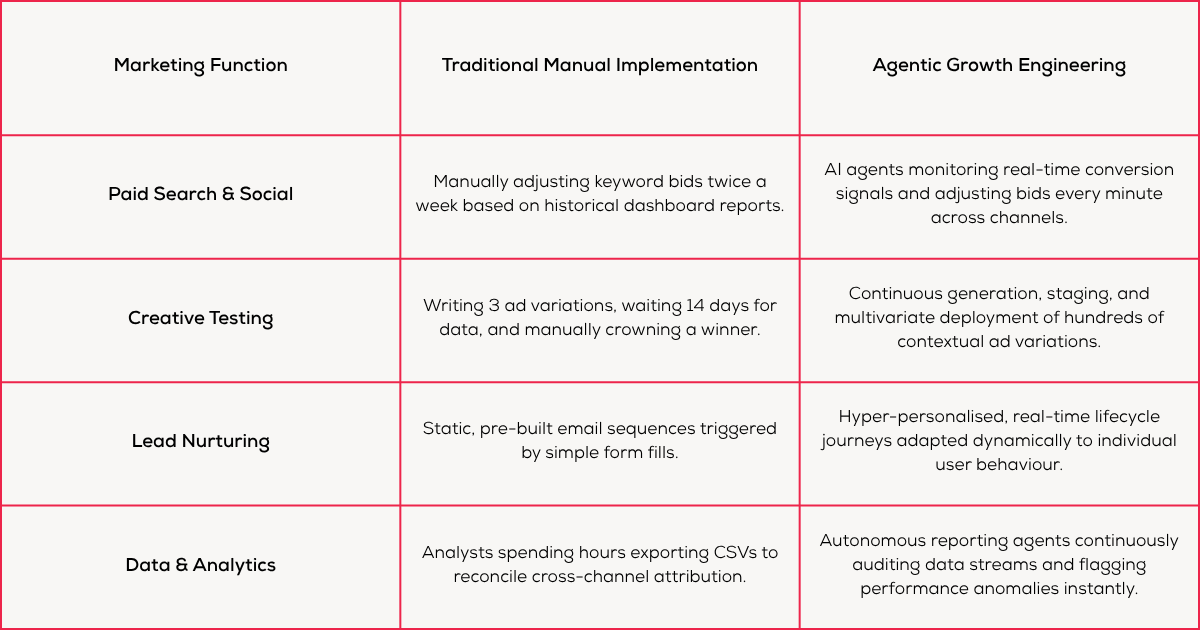
The table below illustrates how agentic systems fundamentally transform day-to-day marketing operations across critical paid and lifecycle channels:
The Strategic Blueprint for Deploying Agentic Systems
Migrating to an agentic marketing framework requires a calculated, phase-based deployment. Because AI agents operate with high degrees of autonomy, building trust through structural safeguards is critical to protecting your brand voice and advertising capital.
Establish the Data Infrastructure:
Phase 1: Foundation.
Clean and unify your first-party data. AI agents are entirely dependent on their data environment. Ensure your Customer Data Platform (CDP) or CRM feeds real-time, uncorrupted customer signals directly to your agentic endpoints.
Configure Guardrails and Constraints:
Phase 2: Governance.
Define the strict parameters within which the agent must operate. This includes maximum daily budget caps, strict brand guidelines, pre-approved messaging frameworks, and forbidden target audiences or keywords.
Deploy Human-in-the-Loop (HITL) Checkpoints:
Phase 3: Validation.
Launch the agents with a mandatory review process. For example, configure your creative generation agents to stage ad copy variations in a draft queue, requiring a senior copywriter to click "Approve" before going live.
Transition to Full Autonomy:
Phase 4: Scale.
Once an agent achieves a verified accuracy and performance threshold (typically 90%+ over a 30-day trial), remove the manual checkpoints on low-risk operational tasks like bid optimisation and anomalous data monitoring.

Unlocking Exponential Returns on Marketing Investment
The business case for agentic systems extends far beyond simple time savings. When teams combine clean data, controlled autonomy, and reliable performance analytics, they can detect underperformance earlier, redirect budget faster, and improve the feedback loop between execution and commercial outcomes.
By removing humans from the mechanical path of data processing and asset deployment, optimisation occurs at machine speed. If an ad variation underperforms in the Singapore market at 2:00 AM, an agent detects the anomaly and shifts the budget allocation immediately—saving thousands of dollars in wasted ad spend before a human marketer even opens their laptop at 9:00 AM.
Ultimately, agentic systems allow scaling enterprises to decouple their revenue growth from marketing headcount. Your team doesn't need to grow linearly with your ad spend. Instead, your existing talent transforms into operators of highly sophisticated, self-optimising systems.
Partner with Singapore’s Growth Architects
The transition from traditional marketing automation to autonomous agentic architectures requires a deep understanding of machine learning models, API integration, and enterprise revenue operations.
At Digital Squad, we design and deploy end-to-end marketing automation frameworks that replace manual friction with predictable revenue velocity. Whether you are looking to integrate advanced lead scoring models into your CRM or deploy agentic guardrails across your global paid media accounts, our team engineers the infrastructure required to scale your business.